
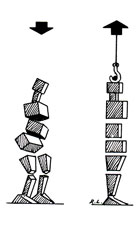
 Use gravity to lift you up
rather than tear you down
Learn healthy posture
& movement patterns
Reduce tension
pain & discomfort
20 years experience
Read my Biography
Structural Integration is a form of deep tissue bodywork incorporating movement and posture education. Unlike a massage this work engages the client in their own unique healing process. The client is an active participant during the sessions; embodying a new way of being, feeling and experiencing their body and its environment. In a session we seek more natural alignment in the joints, increased relaxation of connective tissue, a sense of emotional grounding and balance throughout the body. This deep awareness facilitates more ease of use, efficiency in movement and reduces stress, tension and discomfort.

The Real Science Behind Fascia Ailments
Apparently mainstream media, CNN in this case, is paying attention to fascia which I think is awesome. This kind of publicity for the tissue in the body that historically has been shuffled under the rug in the interest of studying the rest of the human organism. I find it adorable that they refer to fascia as “new” when we’ve been talking about it for a very long time. I mean Ida Rolf began discussing this work as a technique for changing fascia in the 1950’s. I come across this when new clients see me at times, they are so excited about this “new” therapy called Structural Integration. While I’m happy they found me, I also give them a brief history of the work that reaches back much further than they may have realized.
A shot out to my dad for sending me this article, thank Dad!
“Most of you have probably never heard of fascia, or if you have, it may be in the context of “blasting” it to treat cellulite. But talking about fascia has become trendy recently, and not only in the context of looking better in your swimsuit. A Google search returns more than 79 million hits for the term, and there is even a conference, now in its fifth year, that is entirely devoted to fascia research.
What is fascia?
According to Stedman’s Medical Dictionary, fascia is “a sheet of fibrous tissue that envelops the body beneath the skin; it also encloses muscles and groups of muscles and separates their several layers or groups.”
But this definition is incomplete. Fascia can actually be classified into four types, each with different properties, functions and characteristics. The superficial fascia surrounds the body and includes subcutaneous fat; the deep fascia surrounds the musculoskeletal system; the meningeal fascia surrounds the nervous system; the visceral fascia surrounds body cavities and organs.
In mainstream medicine, fascia is rarely considered in isolation as the cause of chronic pain disorders. One exception is plantar fasciitis, a painful and relatively common condition in which the fascia that is responsible for maintaining the arch in your foot is inflamed. The inflammation is directly attributed to a stiffening and a decrease in the flexibility of the fascia, according to orthopedic surgeon and sports medicine physician Dr. Shabi Khan.
The Mayo Clinic references fascia when describing myofascial pain syndrome (“myo” is short for muscle), but according to Khan, there is “little sophisticated knowledge in terms of the functionality or treatment of problems with the fascia,” and “when compared with the muscle and tendon structure, fascia has a much less dynamic role.” He does note that fascia, like most connective tissue in the body, stiffens with age, overuse and injury. The direct role of fascial changes in causing pain and structural changes in conditions such as chronic lower back pain, headaches and cellulite is less clear.
Some body work practitioners including massage therapists, osteopaths, Rolfers, craniosacral therapists and physical therapists claim that fascial restrictions (essentially tightening) — caused by injury, inflammation, trauma, disuse, overuse, misuse or abuse — play an important role in contributing to the pain associated with a wide array of conditions including migraines, fibromyalgia, headaches, lower back pain and women’s health issues…”
Read the full article here.
Liberated Body
I found this podcast a bit late. By that I mean Brooke Thomas has somewhat recently stopped creating new episodes. But there’s an archive of episodes that I think are quite a collection of gems. Brooke is a Rolfer® who works out of New Haven, CT and this series of audio interviews and musings is […]
Rolfing, Cryotherapy, DNA testing: four new wellbeing trends
Move over massage, it’s time to welcome Rolfing. Developed in the 1950s this is a hands-on process used for the treatment of injuries and chronic pain.
