
Structural Integration – The Legacy of Dr. Rolf

Therapeutic bodywork can do amazing things for how we feel and relate to our bodies. Touch brings awareness into the body, providing a tool for communication with our own tissue. Using this awareness we can recognize patterns of tension, stress and strain in our body and consciously release them. In Structural Integration we seek to recognize tissue that is not yielding to change. With attention, full breath, deep touch and core movement we can make space for change to take place, melting through held and unchanging connective tissue and allowing it to release from its contracted state. For many clients this work has provided relief from years of chronic tension, acute injuries, as well as emotional stress. Relieving the body from this pain can have profound effects on day-to-day stress, allowing for more energy and emotional clarity.
Adaptability
The body’s inherent adaptability can cause many movements to become easier if repeated over time. We do this by creating tension throughout our fascial matrix. Beneath the skin our body is contained within a matrix of thin, saran wrap-like connective tissue called fascia. This matrix forms sheaths that envelope all our body’s individual muscles, organs and bones. These sheaths are interconnected throughout our structure and support the skeleton as well as all skeletal movement through their tensile strength, balance and adaptability. Tension, often reflected in the body as excessive muscular tone, is a product of the enveloping fascia holding a muscle in a chronic state of contraction. This affects other muscles by binding the neighboring fascial sheaths together originating from the original held contraction. The process can repeat itself, a “domino effect”, as it is transferred through the body. Using this tensile formation of contracted tissue our fascia can create a false support for any repeated movement, relying on shortened muscle for stability instead of bone. Over time these tensions can become severe enough to cause pain and even major dysfunction, resulting in repetitive stress injuries and related problems. Compensation for the held and misaligned tissue can occur as well, causing the body to adjust its movement patterns to “work around” the contracted tissue. This fascial contraction and inability to change old patterns within the body affects our overall stress level and emotional well-being, it can tear us down physically and emotionally. Awareness is an important tool in changing these patterns. Before change can occur and have a lasting effect we must first have the awareness of living in and from our own tissue. Touch acts as a facilitator along with the client’s own participation utilizing breath, communication and movement.
Awakening Change
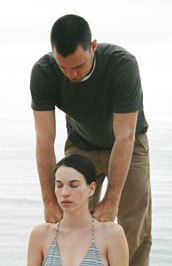 Structural Integration seeks to awaken changes in the body using deep touch, core movement and awareness. Many of us have tension or pain that we learn to live with. As discussed earlier, these tensions can contribute to structural and postural misalignment. This can be holistically addressed through a process of ten 1 ½ hour therapeutic bodywork sessions. This is Ida Rolf’s method of Structural Integration; it’s truly a whole-body approach. The Ten Series reorganizes the body from the ground up and from the superficial to deep layers of connective tissue, providing the client with positive new ways of relating to their body and environment.
The Ten Series Protocol
The Ten Series starts with opening the “sleeve” (superficial fascial layers) of the body. This frees the breath, allowing more space for it to flow into. Breath is vital to this work; it offers a helpful tool that allows for a meditative and focused presence in the body. The first three sessions prepare tissue as well as the client for a deeper level of work. The following four sessions address the “core” (deeper fascial layers) of the body. This work allows for the client to shift deep patterns that may be unwilling to change. We use aligned movement to engage the client during the sessions, this is a way to experientially learn balanced and aligned movement. When movement is balanced we interact more efficiently with our fascia by shortening only the tissue truly necessary and letting the opposing tissue extend. This allows for ease of movement and an improved level of dynamic stability in the body.
The last three sessions in the series are the “integration” sessions. These sessions have an increased focus on client induced movement, clarifying how we move from our body’s core. Core movement refers to the ability to involve the deep musculature of the body. This deep musculature is called the “intrinsic” layer; it is naturally optimized for smaller movements and core stability. When overlooked in day-to-day movement and awareness this can cause the body to overuse the more superficial larger musculature resulting in more effort in all movement. This, the “extrinsic” layer, is naturally optimized for larger movements that require larger muscles. Overusing either layer can cause imbalance and distortion to occur in the body as well as pain that is associated with excessive contraction. When the extrinsic and intrinsic layers work together they can create a unique balance, creating an efficient way for movement to be expressed. This balance can uncover a sense of ease, efficiency and grace that flow through the body.
Opening awareness to the fascial matrix that molds our body can support a more centered state of being. Typically it takes about a year for clients to truly embody the changes that take place within this series. Continued participation with your body is definitely encouraged; exercises done with a structurally balanced intention can help to maintain this awareness. Structural Integration provides tools that can last for a lifetime. Walking, yoga, sports, swimming, virtually any exercise or activity can be done with awareness of structural alignment. Following the ten series maintenance sessions are encouraged, but not always necessary. A one to three month gap between these sessions might be appropriate, depending on your body’s needs.
Problem Oriented Bodywork
Often times new clients come to see me who have a specific area they would like to address. Working with focus on a certain area can create change in the body that helps the healing process. This work is sometimes best suited to be done done outside of the classic ten series protocol. The ten series is designed to be truly holistic and therefore not focused on a specific area. I appreciate the challenge of working with a particular focus while keeping the whole of the structure in mind. Usually this is in a shorter series of sessions depending on the clients specific needs. I recommend we get to a place where there isn’t a persistent nagging issue before moving onto a ten series. This allows the client to be present and attentive to the work during the process of full body integration.
